Expandable braided sleeving works as a braided textile tube. You push it over a large connector, and the mesh opens radially to let it pass. Release it, and the tube contracts for snug coverage around the wire or cable bundle.
That simple behavior comes down to two mechanisms. First, stretch fit: lengthwise compression drives the diameter open, so the sleeve slides on and then grips. Second, coverage: braid density and expansion ratio decide how much protection that fit delivers. Understand both, and you can match expandable braided sleeving to almost any routing job.
Key Takeaways
-
Expandable braided sleeving works by stretching open when you push it lengthwise, then gripping the bundle when released.
-
Coverage depends on braid density and expansion ratio, which control how much protection the sleeve provides.
-
Choose the right material for your environment: nylon for toughness, polyester for general use, fiberglass for high heat.
-
Always secure both ends with heat shrink tubing to prevent fraying and ensure durability.
-
Measure your bundle carefully and avoid over-expanding the sleeve to maintain full coverage and protection.
How Expandable Braided Sleeving Works: Braided Construction
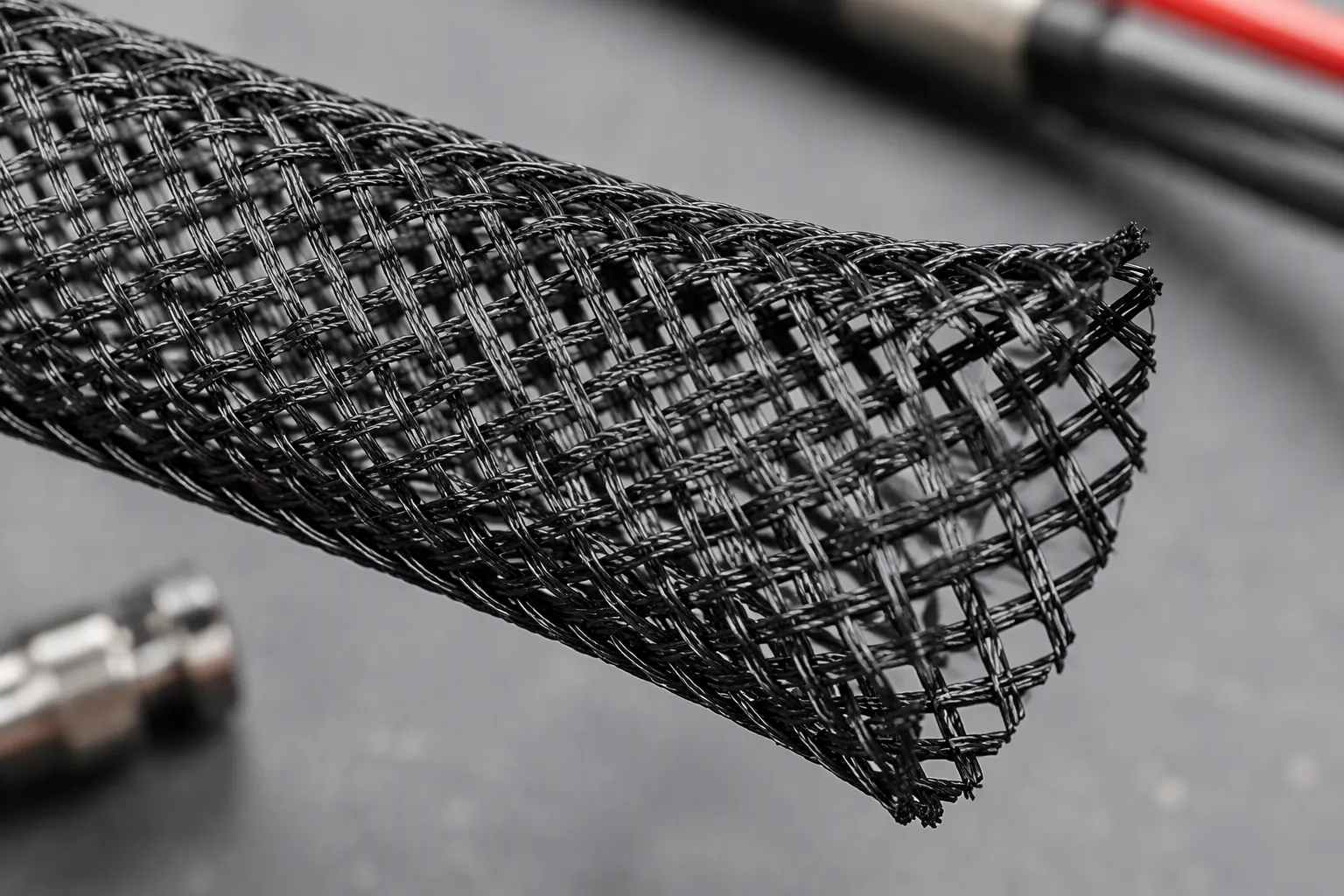
The secret to expandable braided sleeving works sits in the weave itself. Many yarn carriers interlace in a diagonal, bias pattern, crossing over and under one another. That crossing builds a continuous tubular mesh with a lock-stitch structure, so the tube resists unraveling while staying flexible. Each yarn sits at an angle to the tube axis. Push the ends together, and those angled yarns swing toward a wider angle, which opens the diameter. Pull the ends apart, and the mesh narrows again. That geometry is why braided sleeving for wire and cable moves radially without losing its shape.
Yarn Types and Materials
Material choice sets where a sleeve performs best. Nylon (PA 6.6) brings toughness, softness, and resistance to fuels, salts, solvents, and gasoline. It won't rot or hold moisture, so it suits wet applications and irregular shapes like hoses and harnesses in vehicles and industrial equipment. Polyester (PET) covers general-purpose bundling with high tensile strength and extreme flexibility. It resists UV and does not trap heat or humidity. Flame-retardant PET meets UL VW-1, which makes it a fit for ignition-risk areas. Fiberglass handles heat up to 1,200°F and holds a tight structure under vibration and pressure, so it belongs near manifolds and exhaust systems.
|
Material |
Standout Strength |
Where It Fits |
|---|---|---|
|
Nylon |
Abrasion and chemical resistance, softness |
Wet areas, irregular shapes, engine compartments |
|
Polyester |
Flexibility, UV resistance, VW-1 flame retardance |
General bundling, color coding, flame-risk zones |
|
Fiberglass |
Thermal protection to 1,200°F |
Manifolds, exhausts, radiant heat shielding |
The Braiding Process
Machine settings shape the final product. Carrier speed, take-up speed, and tension control all matter, and uniform tension across every carrier keeps the braid even. Braid angle governs the trade-off between radial expansion and axial stiffness. A tighter angle limits expansion for high-pressure hose protection. A shallower angle keeps flexibility for cabling.
Fitting follows a simple sequence. Open the sleeve gradually and feed it over the part without dragging loose yarns against fittings. Slide it to its final spot, spread the excess length, and check coverage before you cut. Mark the cut only after fitting, then record the installed diameter and fitted length. Remember that expandable braided sleeving for cable protection has no fixed diameter, so coverage depends on the actual installed geometry.
The Stretch-Fit Mechanism
Lengthwise Compression, Radial Expansion
Here's the heart of how expandable braided sleeving works. Push the two ends of the tube toward each other, and the braid angle opens. The diameter grows, and the sleeve slides over a bulky connector or a thick plug with room to spare. Let go, and the yarns spring back toward their resting angle. The tube contracts and hugs the bundle.
That behavior makes the sleeve forgiving on real hardware. Expandable braid conforms to bends, tapers, and irregular bundle shapes that a rigid tube would need multiple pieces or fittings to accommodate. A harness that changes diameter along its run stays covered without extra parts.
TechFlex braided sleeving is lightweight and flexible enough to conform to irregular shapes, bulky connectors, and thick plugs, and can be installed over pre-existing runs or bundles without service disruption or disassembly.
That last point matters on a repair job. You can dress an existing run without cutting cables or pulling connectors apart.
Installation and End Securing
The motion is simple: push and slide. Follow these steps for a clean fit.
-
Expand the sleeve lengthwise by gently pushing it so its diameter increases, allowing it to slide over hoses, cables, or connectors.
-
Feed the bundle through the expanded sleeve. For long runs, compress the sleeve in sections, slide gradually, and avoid twisting to keep uniform coverage.
-
Pull the sleeve gently so it contracts around the bundle. Check that it sits evenly, with no gaps or over-stretching, and clears moving parts and sharp edges.
-
Secure both ends to prevent fraying and ensure durability. Heat shrink tubing gives the most professional finish; electrical tape, cable ties, and clamps or ferrules also work.
-
For split sleeving, open the split, insert the cable laterally, close the sleeve around the bundle, and secure the ends.
Two mistakes cost you coverage. A sleeve that's too small over-stretches and loses abrasion resistance. One that's too large slides around and exposes cables. Unsealed ends fray over time, especially under vibration, so heat shrink tubing is strongly recommended. Treat expandable braided sleeving for cable protection as a fitted part, not a loose wrap, and the stretch fit does its job.
How Coverage Is Determined
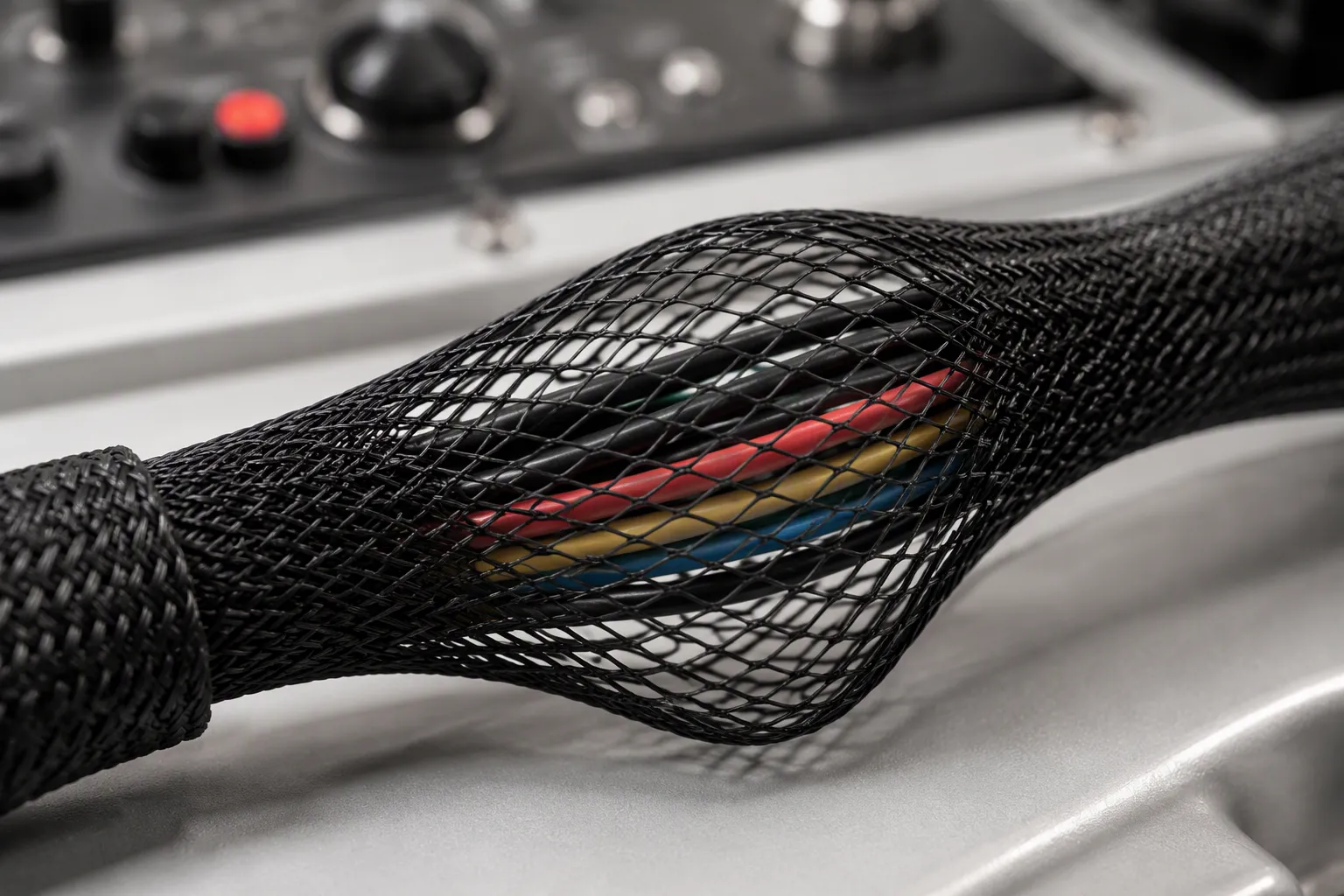
Coverage is not a single number you can print on a label. It comes from two linked properties: braid density and expansion ratio. Braid density tells you how tightly the yarns pack together at rest. Expansion ratio tells you how far the tube can open before the mesh distorts. Together, they set how much of the bundle surface the sleeve actually shields, and how much protection that shield delivers.
Braid Density and Expansion Ratio
Think of braid density as the amount of material per unit of surface. A dense braid packs more yarn crossings into the same area, so gaps between yarns shrink. That tighter weave blocks abrasive grit and cushions the cable underneath. A looser braid opens more easily and drains faster, but it leaves wider windows for debris.
Expansion ratio works the other way. It describes the range between the sleeve's resting diameter and its fully opened diameter. A high expansion ratio lets one sleeve size cover a wide spread of bundle diameters, which simplifies inventory. A lower ratio keeps the braid angle steadier, so coverage stays consistent along the run. This is the practical side of how expandable braided sleeving works: you trade some opening range for a more predictable fit, or the reverse.
Protection and Fit Quality
The open weave does more than hold cables together. Heat escapes through the gaps instead of building up around conductors, which lowers the risk of overheating and electrical fires. Moisture slips through rather than collecting, so water damage and shorts become less likely. That drainage matters most when a harness faces freezing conditions, because trapped water can expand and stress the bundle.
Fluid resistance rounds out the picture. Heavy-duty braided sleeving resists bases, fuels, acids, solvents, and salt, and it can deflect and contain hose ruptures. Marine and offshore settings rely on this around vessel engines, control panels, and switchboards. Automotive runs exposed to engine fluids benefit too, and they gain abrasion resistance at the same time.
Loading capacity separates braided sleeve from rigid alternatives. Braided sleeving is designed for 100% loading capacity, which reduces wire movement and prevents insulation deterioration. Convoluted tubing handles a maximum of 70–80% wire load, and 20–30% must stay free for vibration movement.
|
Criterion |
Braided Sleeving |
Convoluted Tubing |
|---|---|---|
|
Loading capacity |
Designed for 100% loading; reduces wire movement and insulation wear |
Handles 70–80% wire load; 20–30% must remain free for vibration |
|
Wiring protection |
High abrasion resistance; tight weave blocks abrasive material |
Abrasion causes wear and tear |
Fit quality ties these benefits to geometry. A well-chosen expandable braided sleeving for cable protection hugs bends, tapers, and irregular shapes without bridging or bunching. The mesh contracts into contours that rigid tubing cannot follow, so the coverage stays tight where it counts. Cushioning against impact and vibration follows from that same snug contact. Loose sleeve slides and rubs; fitted sleeve absorbs.
Selecting the Right Sleeve
Sizing and Fit
Sizing starts with a measurement, not a guess. Grab a caliper for a single cable, or group multiple cables and measure the total diameter with a flexible tape for irregular shapes. Include connectors, branches, and any bulky section the sleeve must pass over.
Then match that number to the manufacturer's bundle range. A PET sleeve, for example, expands up to 150%, so check the minimum and maximum diameters before you commit. Keep these points in mind:
-
Avoid excessive expansion, even when the sleeve physically fits. Over-expansion cuts longitudinal coverage, widens visible gaps between filaments, shortens installed length, and reduces flexibility and abrasion protection.
-
Allow extra length, because braided sleeving shortens as it expands. The exact shrinkage depends on construction and bundle diameter.
-
Trial-fit a short section before you finalize the order.
Application Priorities
Your operating environment sets the priority order. High temperature, chemical exposure, UV, and mechanical abrasion each push you toward a different material grade. Weigh abrasion resistance and temperature range against the actual conditions, not against a spec sheet in isolation.
|
Sleeve |
Coverage and Abrasion |
Temperature Capability |
|---|---|---|
|
Nylon 6-6 braid |
Tight braid, full coverage, excellent surface abrasion resistance |
Not specified |
|
Fabric-like braid |
High coverage, resists abrasion and cuts; meets MIL-I-47203 and MIL-S-47053 |
Wide range suits engine compartments and near exhausts |
|
Fine nylon |
Ultra-thin, strong bundling for delicate fiber and optic assemblies |
Not specified |
Flexibility comes next. Static runs tolerate a stiffer braid, while moving applications demand resilient sleeving. General-purpose PET is your practical starting point when temperature and abrasion demands stay moderate. Step up to nylon where you want greater toughness, and to high-performance constructions when standard PET falls short. Split and self-closing designs let you install around existing assemblies without disconnecting terminals. MJ FLEX can help you match these specifications to your coverage needs.
Expandable braided sleeving works on a simple idea. Yarns interlace into a helical tube, you compress it lengthwise to open the diameter, and it contracts on its own for a snug fit. Construction, expansion ratio, and material selection all shape that stretch fit and the coverage you get. So measure your bundle, check the expansion range, and pick a yarn that matches your heat, abrasion, and chemical conditions. Then secure both ends. Want help matching specs to your application? MJ FLEX is a solid resource for choosing the right expandable braided sleeving.
FAQ
How do I know which sleeve size to order?
Measure the total bundle diameter, including connectors, then compare it to the manufacturer's minimum and maximum range. A PET sleeve expands up to 150%. Trial-fit a short section before ordering, and remember that expandable braided sleeving shortens as it opens.
Will the ends fray after installation?
They can, especially under vibration. The open weave unravels once a cut edge works loose. Secure both ends with heat shrink tubing for the cleanest finish, or use tape, cable ties, or clamps. Sealed ends keep braided sleeving for wire and cable intact over the long run.
Can I install it over cables that are already connected?
Yes. That's one of the biggest advantages. Push the sleeve lengthwise to open the diameter, then slide it over existing runs without disconnecting terminals. Split and self-closing designs go a step further and wrap laterally around the bundle. No disassembly, no service disruption.
Does the open weave really protect anything?
It does. The gaps let heat escape and moisture drain, which lowers overheating and water damage risk. The tight mesh still blocks abrasive grit and cushions against impact and vibration. For expandable braided sleeving for cable protection, that balance of drainage and abrasion resistance is the whole point.
How much heat can it take?
It depends on the yarn. Fiberglass handles up to 1,200°F, so it suits manifolds and exhausts. Nylon and polyester fit moderate conditions. Check the temperature rating against your actual environment before you commit, and leave margin for radiant heat from nearby components.