Expandable Braided Sleeving protects cables through five mechanisms: abrasion resistance, flexibility, heat dissipation, environmental defense, and electrical insulation. Each one addresses a distinct threat, and together they extend the service life of wire, cable, and hose assemblies.
Mechanical wear drives most failures. Field studies indicate that approximately 70-80% of robot cable failures result from mechanical wear, with abrasion accounting for the majority of these incidents. A protective weave absorbs that punishment before it reaches the conductor or jacket.
The sections below explain each mechanism in turn. They also compare expandable braided sleeves with conduit, tape, and spiral wrap, so readers can judge which option fits a given run.
Key Takeaways
-
Expandable braided sleeving absorbs wear and tear, extending cable life.
-
The braid expands to fit over connectors and then contracts for a snug, tidy fit.
-
An open weave lets heat escape, preventing cable damage from overheating.
-
Choose the right material to block moisture, chemicals, and UV light.
-
A rated dielectric layer adds electrical insulation for safety.
How Expandable Braided Sleeving Protects Cables
Five Protection Mechanisms
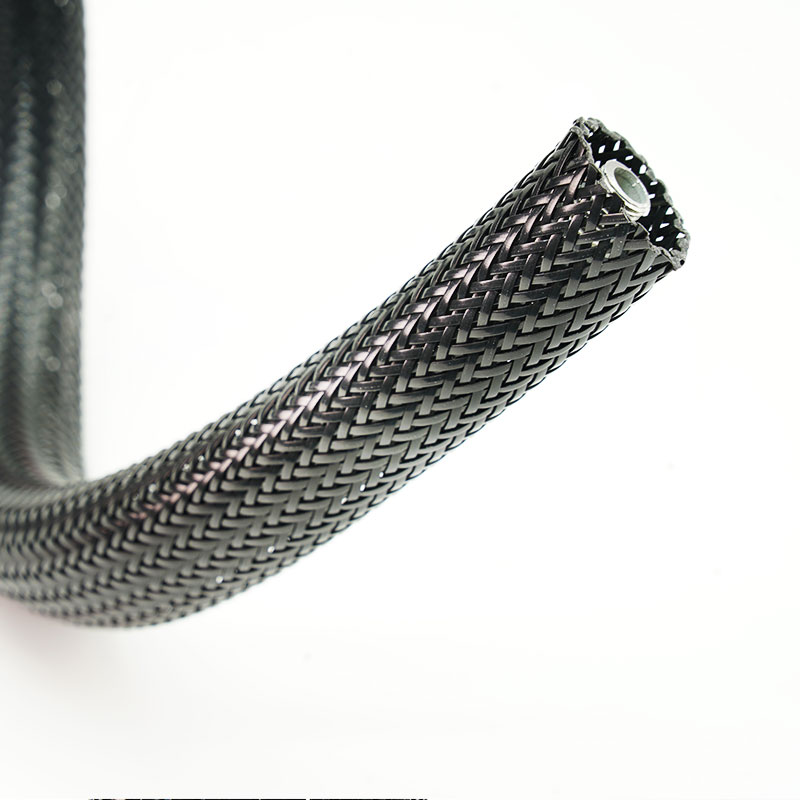
Expandable braided sleeving guards cable assemblies on five fronts. It resists abrasion, flexes with the cable, releases heat through an open weave, defends against moisture, fluids, dust, and UV, and adds a dielectric layer. Each mechanism answers a different failure mode. Abrasion leads the list because it drives most failures. Few alternative methods cover all five as cleanly. A jacket alone handles minor scuffs; a braid handles sustained contact. The five mechanisms work together, and each one earns its own section below.
MJ FLEX builds its product guidance around this five-part model. The brand treats the weave as a system rather than a single feature. A metal braid primarily shields against electrostatic and electromagnetic interference. The interwoven conductive wire acts as a ground-path barrier that attenuates electrical field interference. Non-metallic constructions, typically woven polyester or nylon, focus on wear protection and flexibility instead. Standard PET sleeving handles bundling and abrasion, while rodent-resistant variants add a feature that discourages chewing. That distinction matters during specification. Buyers who match construction to environment get the most from either type. In aircraft, vibration and rough handling can damage individual conductors and cable bundles, so the braid earns its place on critical wiring.
Mechanical Stress and Cable Life
Mechanical stress shortens cable life in predictable ways. Sharp bending at joints concentrates stress beyond the minimum bend radius. The result is mechanical fatigue, conductor breakage, and insulation cracking. Twisting at articulated joints adds torsional stress. High-speed movement and heavy payloads create dynamic loading patterns that static routing cannot address. Crushing and impact deliver sudden loads that crack insulation and deform conductors.
Continuous rubbing against machine frames or bore walls wears the jacket thin. Fatigue accumulates quietly. Each stress type attacks a different part of the assembly. Over thousands of cycles, these forces produce intermittent signals and unplanned downtime.
Expandable braided sleeves interrupt that chain at several points. An expandable braided cable sleeve provides a low-friction protective layer between the cable and the bore wall. It also prevents cables from binding as they twist during rotation. Paired with high-flex robotic-grade cabling, the sleeve reduces friction inside hollow bores and keeps bend angles under control. Reinforced outer layers maintain flexibility while adding crush and impact protection. Strain relief at critical stress points and guided routing complete the picture. The braid absorbs wear before it reaches the conductor or the jacket. Testing of PET braided sleeving in high-dust industrial settings showed the material retained structural integrity after more than 5,000 flex cycles. Suppliers describe the same effect in railway and power plant installations, where the sleeving prolongs wire life under vibration and repeated bending. The sleeve extends the life of industrial cables and harnesses, not just the conductors inside them. Consistent performance over time follows from that protection.
The payoff reaches beyond the cable itself. One industry finding puts the effect in perspective:
Proper cable management techniques — including appropriate protective sleeving — reduce electrical fault incidents by up to 40% in industrial environments. (IEC TC64 working group documentation)
Few upgrades deliver that much return for so little installation effort.
Abrasion Resistance for Long Cable Life
How the Braided Weave Absorbs Wear
A tight braid construction covers the entire assembly and delivers excellent surface abrasion resistance. The weave works on two fronts. Smooth fibers and a tight structure reduce internal abrasion when hoses and harnesses rub against the inner wall. A thick flat-filament braid acts as an abrasion guard on the outside. A dense tubular weave tested per ISO 6945 withstands over 200,000 abrasion cycles without wearing through. That performance separates Expandable Braided Sleeving from a simple jacket.
Material choice sets the wear ceiling. Nylon 6-6 polyamide monofilament offers strong chafing resistance. Flat filaments, such as those in Gorilla Sleeve, add bulk without stiffness. A 15 mil HW construction runs 50% thicker for extreme abrasion. PPS, Teflon PFA, carbonized nylon, ECTFE (Halar), and fiberglass with high-temp resin coating cover harsh chemical and thermal conditions. PET, aramid (Kevlar), ballistic nylon, and stainless steel braid round out the options. Tightly woven nylon also resists contact damage to painted or fragile surfaces.
Best Fits for High-Friction Runs
Several environments reward abrasion-resistant sleeving most:
-
Automotive electronics: cables face vibration, friction, and extreme temperatures. PET sleeves cut wear and lower electrical failure risk.
-
Industrial equipment: high temperature, moisture, and chemical corrosion demand abrasion, heat, and chemical resistance together.
-
Automated machines: robots and robotic arms move repeatedly, so sensitive motion designs need consistent protection.
-
Computer rooms and data centers: shielding, wear resistance, heat resistance, and flame resistance all matter.
-
Ships: engine and control panel areas vibrate constantly, and sleeving secures cabin wires there.
PET's braided structure also avoids static buildup from friction on automated equipment. Nylon 66 monofilament adds toughness at low temperature, which suits automotive runs and irregular shapes. Matching material to motion profile keeps an expandable braided cable sleeve effective over the full service life.
Flexibility, Expandability, and Organization
Fitting Connectors and Tight Bundles
Installers often face a common problem. A connector is already attached, and the sleeve must slide over it. Expandable Braided Sleeving solves this with a woven structure that opens wide and then contracts. The braid accommodates bulky connectors without removing them or disassembling components.
|
Source |
Expansion capability |
How it accommodates connectors and tight bundles |
|---|---|---|
|
Gendian Materials |
Up to 150% of original diameter |
Woven design makes installation simple even with large connectors |
|
Primus Cable |
At least 1.5 times initial dimension |
Provides slack to fit over bulky connectors and bundled cables |
|
IBOCO |
Expands to 100% of original diameter |
Flexible sleeves suit applications requiring diameter growth |
"Sleeve can expand at least 1.5 times the initial dimension"
This slack matters during field repairs. A technician can push the sleeve over a splice or a large plug and then let it settle around the bundle. The expandable braided cable sleeve also stretches along its length. One supplier notes that these flexible sleeves can stretch to 42% of their initial length. That movement gives installers room to work in tight cabinets and behind panels.
Tidy Runs and Professional Finish
A finished run should look clean and stay accessible. Expandable braided sleeves deliver both. The open weave expands for easy installation and then contracts to fit snugly around the bundle. That snug fit reduces clutter and creates a streamlined appearance. Visible runs in windowed PC builds or automotive interiors benefit from this uniform look.
Organization improves as well. The braid holds cables together in a single traceable path. Technicians can follow one run without sorting through loose wires. Color options support functional coding, so crews can mark power, signal, and ground lines by sight. The braid also conforms to bends, tapers, and irregular shapes that rigid tubing cannot handle without extra fittings. A protective outer layer reduces wear where cables rub against chassis edges or moving parts. That functional gain matters under vibration. The result is a run that looks professional and performs reliably.
Heat Dissipation and Environmental Defense
Open Weave and Heat Release
Cables generate heat during operation. Trapped heat degrades insulation and shortens service life. An open weave gives that heat a path out. Flex-Tuff® uses an open weave construction that permits complete drainage, prevents condensation, and provides dissipation of both heat and moisture. The braid lets air move through the sleeve instead of sealing warmth against the cable.
Flex-Tuff® is described as having an open weave construction that permits complete drainage, prevents condensation, and provides dissipation of both heat and moisture.
Polyester and PET constructions share this trait. Braided polyester offers good wear resistance, fire resistance, and heat dissipation. A tight woven mesh still lets liquid flow in and out without accumulation, which supports airflow. Double-layer and self-wrapping variants carry the same heat-release property. Installers working near engines or inside dense electronics cabinets gain a real thermal advantage from this design.
Moisture, Fluids, Radiation, and UV
Environmental threats reach cables from every direction. Moisture, dust, chemicals, fuels, and sunlight all attack the jacket. Material choice determines which threats a sleeve handles best.
|
Material |
Key environmental strength |
|---|---|
|
PET |
Superior moisture resistance; resists gasoline and automotive fluids; highly UV resistant |
|
Nylon |
Effective at rebuffing moisture in wet applications |
|
PPS |
High chemical resistance; inert to fuels, acids, strong bases, and steam |
|
Nomex |
Superior moisture and chemical protection; resists X-ray, beta, and gamma radiation |
Electronics and automotive harnesses are common application areas. Automotive runs face fuels, salts, solvents, and de-icing fluids. Hybrid and electric vehicles add salt-spray exposure and EMI concerns. UV-resistant constructions suit outdoor exposure, sunlight, and temperature cycling. Expandable Braided Sleeving lets specifiers match the material to the environment rather than defaulting to one option. A Nomex braid suits radiation-prone settings, while a PET sleeve fits wet, sunlit automotive runs. That flexibility keeps the protection aligned with the actual threat.
Insulation and Comparison With Other Methods
The Dielectric Layer Explained
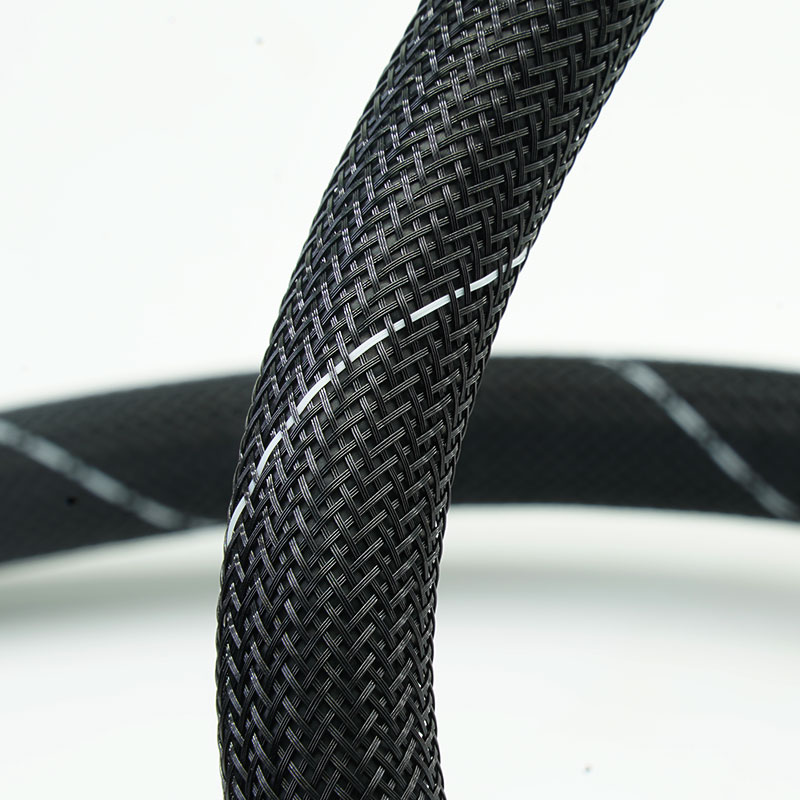
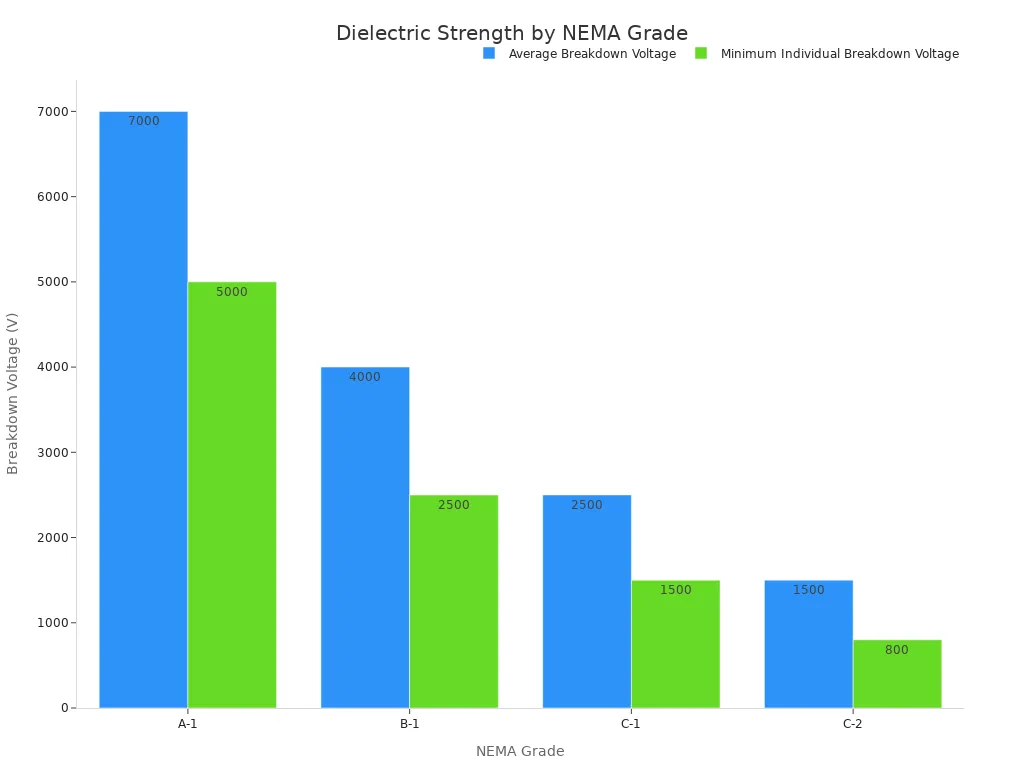
A braided sleeve can act as an electrical barrier, not just a physical one. Dielectric performance depends on the construction and the impregnant applied to the base yarn. NEMA grades set the benchmark. Grade A-1 sleeving averages 7000 V breakdown with a 5000 V minimum individual value. Grade B-1 drops to 4000 V average and 2500 V minimum. Grade C-1 averages 2500 V with a 1500 V floor, and C-2 averages 1500 V with an 800 V minimum. Grade C-3 carries no dielectric guarantee, so specifiers should treat it as mechanical protection only.
Temperature index matters alongside voltage. Type 4A and 5A sleeving, built on inorganic-base yarns with silicone resin, PTFE, or silicone elastomer coatings, rate for 200°C continuous use. Type 6A reaches 155°C, Type 2A reaches 130°C, and Type 3A reaches 105°C. For sleeving Types 3, 4, and 5, breakdown values rise to 8000 V average and 6000 V minimum individual. Matching grade to circuit voltage keeps the margin safe.
Sleeving vs. Conduit, Tape, and Spiral Wrap
Each method fits a different job. Rigid conduit wins on crush protection but offers low flexibility, difficult installation, and hard maintenance access. Spiral wrap delivers flexibility, reusability, and quick installation without specialized tools, and it supports cable breakouts. Expandable Braided Sleeving brings high flexibility, easy installation, expansion to fit varying cable sizes, and a clean appearance. High-temperature woven variants beat both options in hot environments.
Cost and compliance shift the picture. PVC spiral wrap runs roughly $0.15–$0.40 per meter, and UL/CSA-certified variants cost about 2.5 times more. Braided sleeving sits at the higher tier per meter. Metal-reinforced spiral conduit certified to UL 62 and CSA C22.2 No. 62 adds limited EMI shielding of about 20–30 dB at 100 MHz. Verify UL VW-1, CSA C22.2, or RoHS compliance only when local code or heat exposure demands it. Expandable braided sleeves remain economical and easy to install once the material matches the environment.
Expandable Braided Sleeving protects cables on five fronts. The braid absorbs abrasion before wear reaches the jacket. Its weave expands over connectors and contracts into tidy, flexible runs. An open construction releases heat instead of trapping it. Material choice blocks moisture, fluids, and UV. A rated dielectric layer adds electrical insulation.
Readers should match construction and material to the actual environment. MJ FLEX offers product guidance for that selection. One solution covers wear, motion, heat, environment, and voltage together. Expandable Braided Sleeving protects cables by combining all five mechanisms in a single woven layer.
FAQ
Which material suits an outdoor automotive run?
PET handles that job well. It resists gasoline, automotive fluids, and UV exposure, and it dissipates heat through the weave. Nylon offers good moisture resistance for wet applications. Specifiers should match the expandable braided cable sleeve material to the specific threats along the route.
How much does the sleeve expand during installation?
Expansion varies by construction. Suppliers cite figures from 100% to 150% of the original diameter, and some sleeves stretch along their length as well. That slack lets installers slide expandable braided sleeves over attached connectors without disassembling the harness.
Does the weave trap heat in enclosed cabinets?
No. An open weave lets air move through the braid and releases heat instead of sealing it against the cable. The same construction permits drainage and prevents condensation. Dense electronics cabinets and engine bays both benefit from this airflow.
Which NEMA grade fits a high-voltage circuit?
Grade A-1 carries the highest dielectric rating, with a 7000 V average breakdown and a 5000 V minimum. Lower grades suit lower voltages. Grade C-3 offers no dielectric guarantee, so treat it as mechanical protection only. Match the grade to circuit voltage.
When does conduit beat sleeving?
Rigid conduit wins on crush protection and suits fixed runs with heavy impact risk. Expandable braided sleeving brings flexibility, quick installation, and expansion over connectors. Spiral wrap fits breakouts and reusable access. Each method has a clear best-fit case.