Which expandable braided sleeving material fits your application? The answer shapes protection, longevity, and cost. You will encounter several families: PET, nylon, fiberglass, aramid, metal, and engineering plastics such as ECTFE, PEEK, PFA, and PPS. Each material delivers distinct benefits. This braided cable sleeves guide compares them on performance and fit. MJ FLEX supplies every option, so the comparison stays objective. Match the material to your temperature, abrasion, and budget needs. A poor match weakens your cable protection system. A good match extends service life. Use this guide to choose wisely.
Key Takeaways
-
PET sleeving offers a flexible, economical solution for general cable protection with moderate heat and abrasion resistance.
-
Nylon sleeving provides extreme abrasion resistance and flexibility, making it ideal for high-movement environments like automotive and robotics.
-
Fiberglass, aramid, and metal sleeving handle high heat, flame, and EMI shielding for specialty applications.
-
Engineering plastics like PEEK, PPS, ECTFE, and PFA resist chemicals and extreme temperatures for demanding environments.
-
Proper sizing and material matching ensure optimal protection and cost-effectiveness for your cable system.
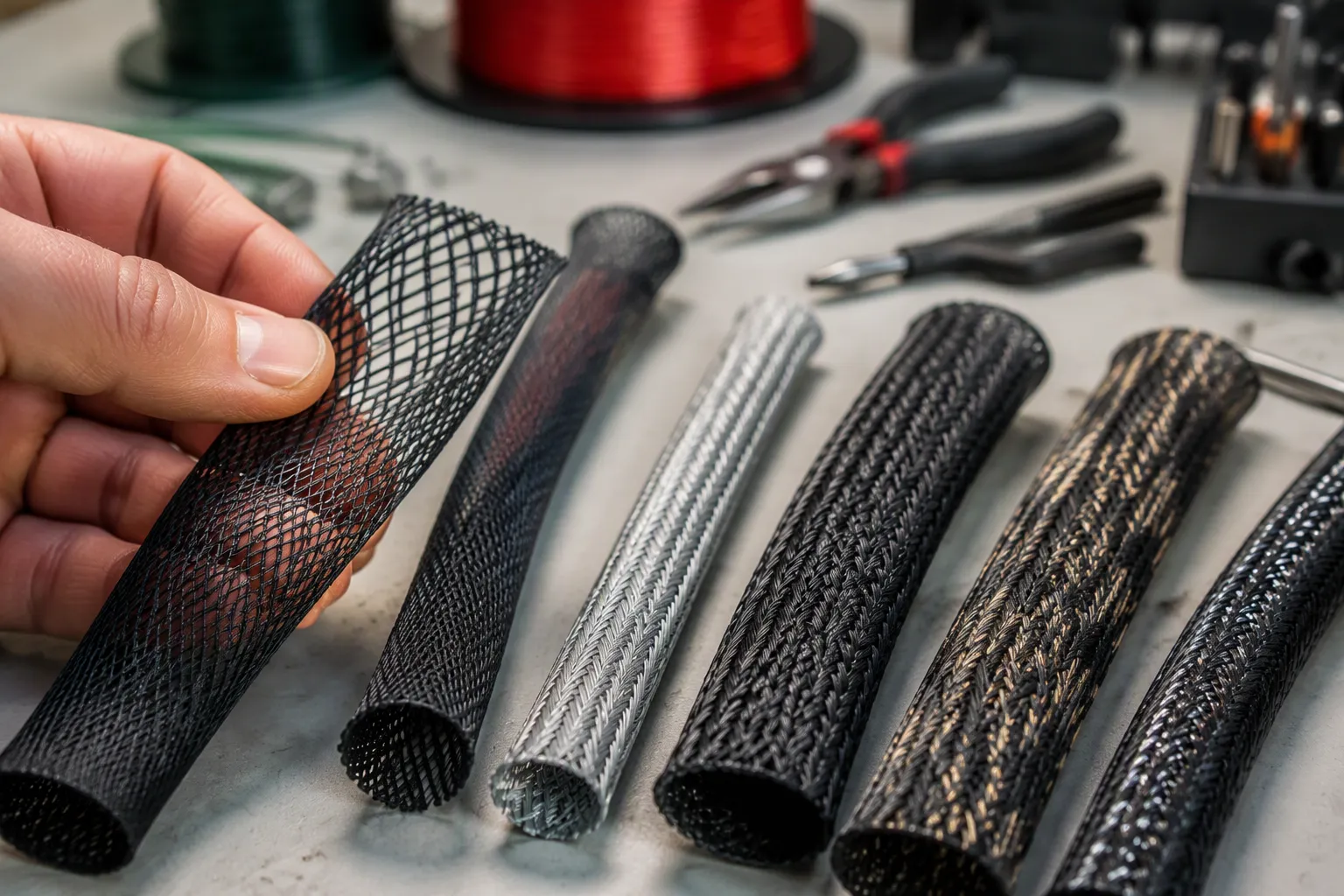
PET Expandable Braided Sleeving
Properties and Performance
Polyester (PET) ranks as one of the two most common braided sleeving types, alongside fiberglass. You get a flexible, expandable sleeve that stretches to twice its relaxed diameter, so bulky connectors pass through with ease. The braided structure lets air circulate around the wires, which helps them run cooler. PET also resists wear and corrosion, and it generates no static electricity from friction on automated equipment.
Temperature ratings vary by grade. Common figures include −50°C to 150°C, −40°C to +125°C, and a maximum operating temperature of 125°C (257°F). The melting point sits between 215°C and 275°C (419°F to 527°F). Abrasion resistance rates moderate to high — tougher than basic textile sleeving, though not the maximum-durability option.
|
Material |
Abrasion Resistance Rating |
|---|---|
|
PET Braided Sleeving |
Moderate to High |
|
Nylon Braided Sleeving |
Extreme / Superior |
An abrasion result should not be used as a substitute for a chewing evaluation, and a rodent-resistant label does not automatically mean better abrasion performance than every standard PET sleeve—braid density and filament dimensions can differ substantially between grades.
Best Uses and Cost
PET expandable braided sleeving meets wear-protection requirements across many fields. In automotive applications, you can route these braided cable sleeves near engines to guard against oil, heat, and vibration. In electronics, the same braided cable sleeves protect wiring in data centers, computer classrooms, and laboratories. They add shielding, heat resistance, and flame resistance (VW-1 rated), and they improve wire identification.
Cost drives adoption. Expect roughly £1.25 per meter, and wide availability keeps global consumption high. Polyester braided cable sleeves suit price-sensitive markets well. Polyester braided cable sleeving also offers UV resistance, which helps in outdoor runs. For general-purpose cable protection, PET braided cable sleeves balance performance and budget. Choose these braided cable sleeves when heat stays moderate and abrasion stays light to medium. A braided cable sleeve in PET handles everyday bundling without strain.
Nylon Braided Cable Sleeves
Abrasion Resistance and Flexibility
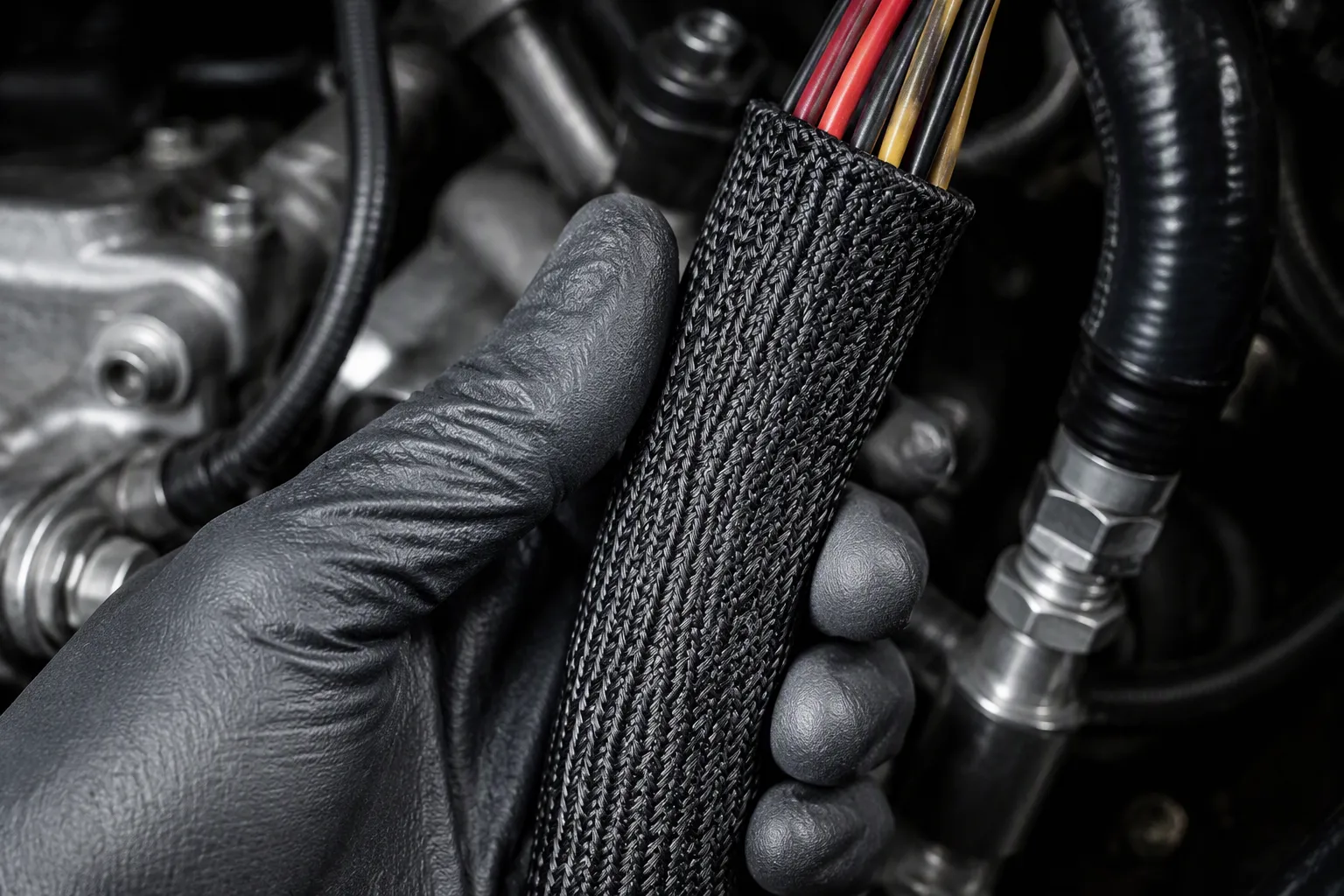
Nylon braided cable sleeves lead the field in abrasion resistance. The material handles heavy movement, vibration, and sharp edges with ease. Automotive engine bays and robotics stand as classic examples of these demanding conditions. Heavy-duty nylon hose sleeving resists harsh chemicals, fuels, and outdoor exposure, and one grade is rated to withstand over 50,000 abrasion test cycles. Woven ballistic nylon adds another layer of defense. It deflects high-pressure hose ruptures and offers UV protection.
Flexibility matches that toughness. Nylon provides good mechanical strength and flexibility, and it suits cable assemblies that experience repeated movement or increased mechanical stress. Compare this with fiberglass:
Fiberglass sleeving is less flexible than PET, so allow for wider bends.
Nylon also manages large wire bundles well. The expandable braid opens wide, then grips the bundle once you release it. Check six factors when you plan a route: minimum bend radius, frequency of movement, direction of movement, cable weight, installation routing, and abrasion points. These braided cable sleeves reward careful routing with long service life.
Ideal Applications
Where do braided cable sleeves in nylon fit best? Start with high-movement environments. Nylon outperforms PET on abrasion, and PET suits standard settings better. Self-closing woven wrap styles serve automotive, industrial, and high-heat applications. They combine high abrasion resistance with flame retardancy. These braided cable sleeves also shine in non-electrical roles. Hydraulic hose protection is one example. Aesthetic cable finishing is another.
The braided cable sleeve uses and benefits extend past simple organization. You get abrasion protection, a clean finished look, and bundling for hoses and lines that carry no current. That range explains where to use braided cable sleeves across workshops and plants. For cable protection under constant stress, nylon braided cable sleeves are a strong default. Choose this braided sleeving when durability outranks budget. The braided cable sleeve in nylon earns its place in automotive applications and other punishing settings.
Fiberglass, Aramid, and Metal Sleeving
Heat and Flame Performance
High-temperature and specialty environments demand more than general-purpose sleeving can give. Fiberglass, aramid, and metal braided cable sleeves answer that demand. Fiberglass leads on raw heat tolerance. The braided E-type fiberglass sleeve withstands continuous exposure to temperatures of 1200°F / 648°C, with higher intermittent exposure possible.
The braided E-type fiberglass sleeve withstands continuous exposure to temperatures of 1200°F / 648°C, with higher intermittent exposure possible.
That ceiling makes high temperature woven sleeving the standard choice near furnaces, exhaust runs, and molten-metal equipment. Aramid adds flame performance of its own. Aramid braided sleeving is available in UL 94 V-0 rated options, indicating it can achieve the UL 94 V-0 flame resistance rating. You also get inherent flame retardancy plus reliable mechanical protection, so nomex braided cable sleeves suit dynamic installations that see both heat and motion. This flame and heat resistance covers high temperature and flame resistance needs in automotive applications and foundry work alike.
Strength, EMI, and Fit
Fiberglass construction delivers maximum flexibility and expansion. Expandable braided fiberglass sleeves stretch to approximately two times their relaxed diameter, so they slide over fittings, couplings, and other in-line obstructions. Aramid brings high tensile strength, cut and abrasion resistance, and a flexible drape. Metal sleeving handles the jobs the others cannot. It blocks electromagnetic interference and shields against extreme mechanical and thermal punishment.
Fit matters as much as strength. You size high temperature woven sleeving around the largest connector, not the bundle alone. The benefits of braided cable sleeves here include heat resistance, flame and heat resistance, and durable cable protection in one part. Choose high temperature woven sleeving when heat dominates. Pick aramid when strength and flame ratings share priority. Reach for metal when EMI or extreme protection decides the design. Each option earns its place, and each one rewards a careful match to the environment.
High-Performance Engineering Plastics for Braided Cable Sleeve
ECTFE, PEEK, PFA, and PPS
Some environments defeat general-purpose materials. Strong solvents, constant heat, and sunlight demand a different class of braided cable sleeves. ECTFE, PEEK, PFA, and PPS fill that role. Each one fits a distinct set of conditions, so you match the plastic to the job rather than crowning a single winner.
PEEK braided cable sleeves carry a continuous operating temperature of 260°C. The working range runs from −70°C to 260°C, and mechanical properties hold at constant temperatures up to 260°C. That profile suits engine bays, ovens, and industrial equipment. PFA and PPS extend your options for chemical and thermal extremes. PPS yarn resists acids, alkalis, and organic solvents, and it holds a Level A rating for acetic acid, sulfuric acid (10%), sodium hydroxide, and methanol. These high temperature woven sleeving options protect runs that standard sleeving cannot survive.
Chemical and UV Resistance
ECTFE braided sleeving resists a wide range of corrosive chemicals and organic solvents. The list covers strong acids, strong bases, organic solvents, corrosive industrial fluids, and hydrocarbon exposure. It also keeps useful properties after Cobalt 60 radiation at doses up to 200 megarads. You gain heat resistance and chemical protection in one part.
PPS adds broad resistance across many media. The ratings below use a 1-to-5 scale, where 1 means no effect.
|
Chemical / Condition |
Rating |
|---|---|
|
Strong Acids |
1 |
|
Strong Bases |
1 |
|
Chlorinated Solvents |
1 |
|
Hydraulic Fluid (MIL-H-5606) |
1 |
|
UV Light |
1 |
UV light scores 1, so PPS braided cable sleeves suit outdoor runs. These high temperature woven sleeving grades also deliver heat resistance for demanding plants. Choose high-temperature woven sleeving in PPS for chemical and UV exposure. Select PEEK for the highest continuous heat. Pick ECTFE for aggressive solvents. Each braided cable sleeve earns its place, and each one rewards a careful match.
Determining the Right Cable Sleeve Size and Material
Matching Material to Application
Sizing starts with the bundle, not the sleeve. Measure the total bundle diameter, including connectors, branches, and bulky sections. Then match that figure to the manufacturer's minimum and maximum bundle range. Expansion ratio defines the span between the resting diameter and the fully opened diameter.
The woven design offers a considerable area of expansion to accommodate a large range of diameters with an approximate 3:1 expansion ratio, allowing the sleeving to cover various cable sizes and irregular shapes while maintaining consistent protection.
A high expansion ratio lets one size cover a wide spread of bundle diameters. A low ratio holds a steadier braid angle and gives more consistent coverage. Watch for over-expansion. Even when the sleeve physically fits, excessive stretching reduces longitudinal coverage, widens filament gaps, and shortens installed length. Braided sleeving also shortens as it expands, so allow extra length and trial-fit a short section before ordering. Managing braided cable sleeve ends well keeps the finished run tidy and secure.
Movement decides flexibility. Static runs tolerate stiffer constructions. Moving applications need more flexible and resilient sleeving. Match the material to the harshest condition, not the average one. Temperature, abrasion, chemical exposure, and service life all shape the choice. PET covers general duty, nylon handles heavy abrasion, and high temperature woven sleeving serves hot zones. For expandable braided sleeving for wire protection in mixed conditions, weigh each factor in turn.
Balancing Compliance and Cost
Compliance narrows the field fast. UL/CSA 224 covers electrical insulation tubing and includes flammability and VW-1 testing. RoHS restricts lead, mercury, cadmium, and other substances in electrical equipment. REACH requires SVHC reporting for the EU market. FMVSS 302 caps interior burn rate at 4 inches per minute for automotive work. MIL-I-631 and MIL-I-7444 apply to military and low-temperature applications. Confirm the standard your project must meet before you compare prices.
Cost follows material and grade. PET stays economical for volume runs. Nylon costs more and earns it back in abrasion resistance. Fiberglass, aramid, metal, and engineering plastics carry premium pricing for extreme duty. Balance the budget against the cost of failure. A cheaper sleeve that fails early costs more over the service life.
MJ FLEX supplies every option compared here, so this braided cable sleeves guide stays neutral. Use it as a decision framework. Match material to temperature, abrasion, flexibility, compliance, and budget. Then confirm the cable sleeve size against the bundle range. Selecting the right sleeving protects the whole cable protection system. For expandable braided cable sleeving across demanding projects, the right material and size do the real work. These braided cable sleeves reward careful specification, and the right braided cable sleeve pays for itself. A final check of the braided cable sleeves guide before ordering saves rework.
Match each material to its strength. PET serves general-purpose economy. Nylon delivers abrasion resistance and flexibility. Fiberglass handles heat. Aramid and metal cover specialty strength and EMI shielding. Engineering plastics meet chemical and thermal extremes. Let temperature, abrasion, flexibility, compliance, and budget drive your choice. Treat this comparison as a decision framework for expandable braided sleeving for wire protection. Then confirm the size against your largest connector. MJ FLEX supplies every option here, so ask the team to match a material and size to your project. The right braided cable sleeves protect your whole system. Careful specification of these braided cable sleeves pays for itself, and this braided cable sleeves guide gives you a solid start. One braided cable sleeve, correctly chosen, outlasts a cheap substitute.
FAQ
Which material suits general-purpose cable protection?
PET is the economical default. It expands to twice its relaxed diameter, resists wear and corrosion, and carries a VW-1 flame rating. Choose PET braided cable sleeves when heat stays moderate and abrasion stays light to medium.
When should you choose nylon over PET?
Pick nylon when abrasion dominates. One grade survives over 50,000 abrasion test cycles. Nylon braided cable sleeves also handle large bundles and repeated movement well. They cost more than PET, and they earn that premium in punishing settings.
How do you size expandable braided sleeving for wire protection?
Measure the full bundle diameter, including connectors. Then compare it to the manufacturer's bundle range. A 3:1 expansion ratio covers many sizes, but over-stretching widens filament gaps and shortens installed length. Trial-fit a short section first.
What handles heat, EMI, or chemical extremes?
Fiberglass withstands continuous exposure to 1200°F / 648°C. Metal blocks electromagnetic interference. PEEK holds 260°C continuously, and PPS resists acids, solvents, and UV light. These braided cable sleeves serve environments that defeat general-purpose materials.
How do you finish the cut ends cleanly?
Heat-seal cut ends on synthetic sleeving to stop fraying. Managing braided cable sleeve ends well keeps the run tidy and secure. Check braided cable sleeve ends after installation, and trim any loose filaments before you close the bundle.